Rockwool Fibre Staggered Structure
Rockwool fibre staggered structure: fibres perpendicular to the facing and high-density strips staggered along the panel length, for handmade rockwool panels.
- Handmade rockwool panel: fibres perpendicular to the metal panel.
- High-density rockwool strips staggered along the panel length.
- Company materials link this structure to better load-bearing behaviour and a clear reduction in noise transmission. No load or decibel figure is stated.
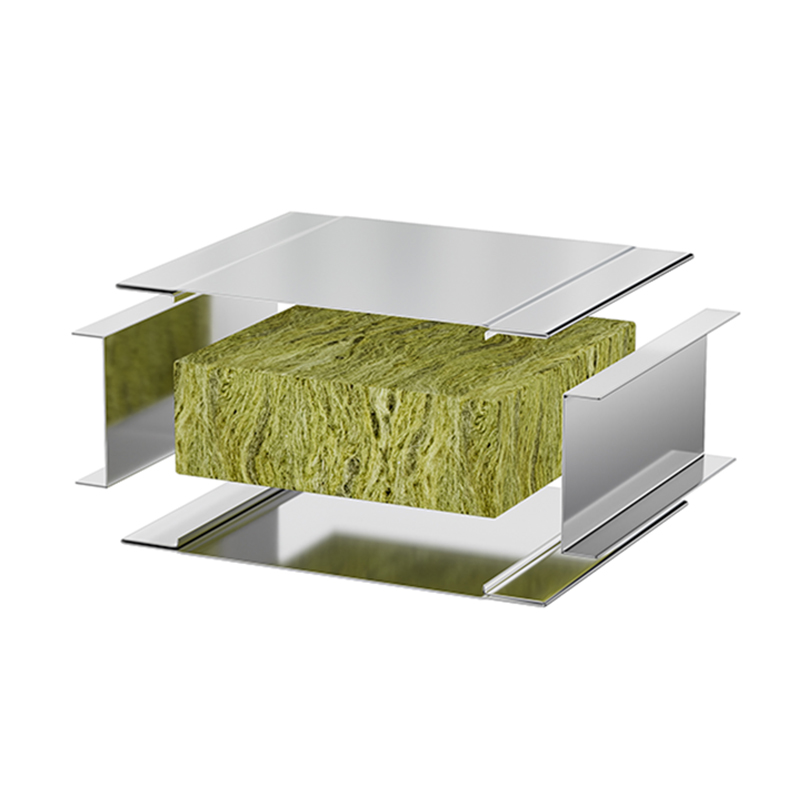
The structure in plain terms
Imagine the panel as a sandwich. The two outer layers are metal facings. Between them sits rockwool, but not as a loose fill: in the handmade panel, the rockwool fibres stand perpendicular to the facings, like the bristles of a brush standing up from a surface, and the high-density rockwool strips are laid in a staggered pattern along the length of the panel, so the joints between strips are offset from one another rather than lining up. That staggered, upright-fibre arrangement is the handmade panel's structural signature, and it is the reason the company materials describe the panel as having better load-bearing behaviour than a panel without that arrangement.
What the structure is linked to, and what it is not
The company materials link the staggered structure to two outcomes: better load-bearing behaviour, and a clear reduction in noise transmission. The first matters where a panel must support fittings or hold its shape in a ceiling. The second matters where a wall must separate a noisy area from a quiet one. Neither link is given a number on this site: no load capacity, no deflection limit, no fibre diameter, no thermal conductivity value and no decibel reduction are stated, because the company materials used for this site give none of those values for this structure. A diagram on this page is labelled as a diagram; it explains the arrangement, and it is not presented as a photograph of a cut panel.
The structure description belongs to the handmade rockwool panel. It is not transferred to the machine-made panel, which is described through its continuous roll-pressed construction and its tongue-and-groove joint. Keeping the structure with its panel type prevents a buyer from ordering a machine-made panel on the basis of a handmade structural claim.