Rockwool Sandwich Panel for Cleanroom Walls and Ceilings
Rockwool sandwich panels for cleanroom walls and ceilings: handmade Type 50 and machine-made 1150 type panels, with thickness, density and joint choices explained.
- Handmade rockwool panel, Type 50: thickness 50 mm, customisable to 75 / 100 mm; rockwool density 60–120 kg/m³ (company catalogue).
- Machine-made rockwool tongue-and-groove panel, 1150 type: thickness 50–150 mm; rockwool density 60–120 kg/m³ (company catalogue).
- Machine-made rockwool: the catalogue describes it as A1 grade fireproof rockwool. No fire-resistance time is stated on this site.
- Company: Foshan Lairun New Building Materials Co., Ltd., Danzao, Nanhai District, Foshan, Guangdong, China.
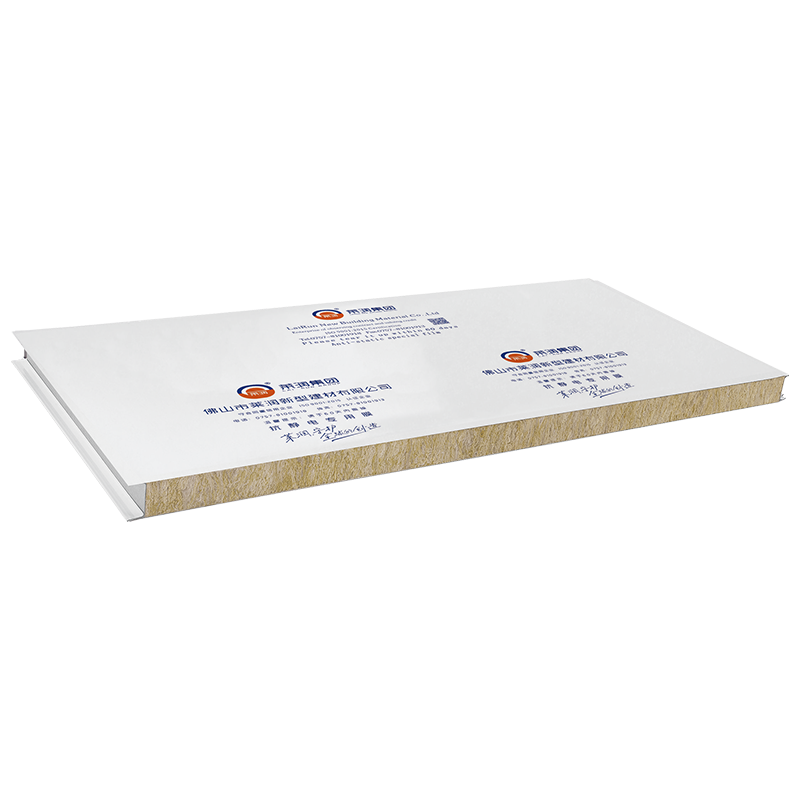
Rockwool panel range at a glance
This site covers one core material family only: rockwool sandwich panels for cleanroom interior walls and ceilings. The range is organised by how the panel is made, not by inventing new products. Handmade panels are built around a galvanised steel keel frame with edge wrapping, which suits projects that need stronger load-bearing behaviour and on-site flexibility such as pre-formed conduit routes and pre-cut openings. Machine-made panels are produced by continuous automated roll pressing with a tongue-and-groove joint, which suits projects that value faster jointing on site. Both routes use rockwool as the core, and both are described in the company materials as providing fire, sound and heat insulation performance in the panel sense, without attaching test numbers that the company materials do not give.
The distinction matters at inquiry stage because thickness, density and joint type are not interchangeable across the two routes. A handmade panel is ordered in its own thickness set and joint options, while a machine-made panel is ordered in the 1150 type tongue-and-groove system. This site therefore keeps the two routes on separate detail pages and cross-links them on every comparison page, so a buyer can check which route matches a wall schedule before sending an inquiry.
Why rockwool core for cleanroom walls and ceilings
Rockwool is made by melting basalt and other natural minerals at high temperature and forming fibres. In the handmade panel, the fibres stand perpendicular to the metal facing, and high-density rockwool strips are laid in a staggered pattern along the length of the panel. That structure is the reason the company materials link handmade rockwool panels to better load-bearing behaviour and to a clear reduction in noise transmission, and they describe the panel as suitable for spaces with high sound insulation requirements. In the machine-made panel, rockwool is presented as a non-combustible, heat-insulating and sound-insulating core material, and the catalogue describes the machine-made rockwool panel as A1 grade fireproof rockwool. Those two descriptions belong to different panel types and are kept separate on this site: the A1 wording is used only for the machine-made panel, with its catalogue attribution attached every time.
Applications on this site are limited to what the company materials support: interior partition walls and ceilings in cleanrooms. That includes clean production areas, laboratories and food plants where the wall and ceiling system must be easy to clean, jointed tightly and consistent in appearance. This site does not present rockwool panels as roof panels or exterior cladding, because the company materials used for this site support wall and ceiling use only.
Thickness and density at a glance
| Panel route | Thickness (company catalogue) | Rockwool density (company catalogue) | Joint |
|---|---|---|---|
| Handmade rockwool panel, Type 50 | 50 mm; customisable to 75 / 100 mm | 60–120 kg/m³ | Male-female joint, or centre-aluminium joint |
| Machine-made rockwool tongue-and-groove panel, 1150 type | 50–150 mm | 60–120 kg/m³ | Tongue-and-groove joint |
Density is shown as a range that can be set to customer requirements. This site does not convert a density value into a performance claim, because the company materials do not give a density-to-performance table. When density matters for a project, send the room use and the thickness under consideration and ask for a density check in the inquiry, rather than assuming a higher density alone settles the selection.
Joints: tongue-and-groove, male-female and centre-aluminium
Machine-made panels use a tongue-and-groove joint in the 1150 type system. Handmade panels use a male-female joint, or a full female opening fitted with a centre-aluminium joint. The joint choice affects how a wall run is set out, how corners and openings are handled, and how easily a single panel can be removed later. The joint installation page on this site explains each joint in the company materials' own wording, without adding installation dimensions that the company materials do not state.
Send a panel schedule for checking
A useful inquiry lists the wall and ceiling areas separately, the panel route preferred, the thickness range, the density range, the joint type, the panel colour, and any pre-formed openings or conduit routes needed for handmade panels. That schedule lets the supplier check the variant before ordering, instead of confirming a generic panel. Use the inquiry checklist page for the full list of items to confirm before ordering.